Poppies will make you Sleepy, 2026
Woodcut
Edition of 30
29 3/4 x 21 3/4 in.
Collaborative Printer: Alexis Nutini
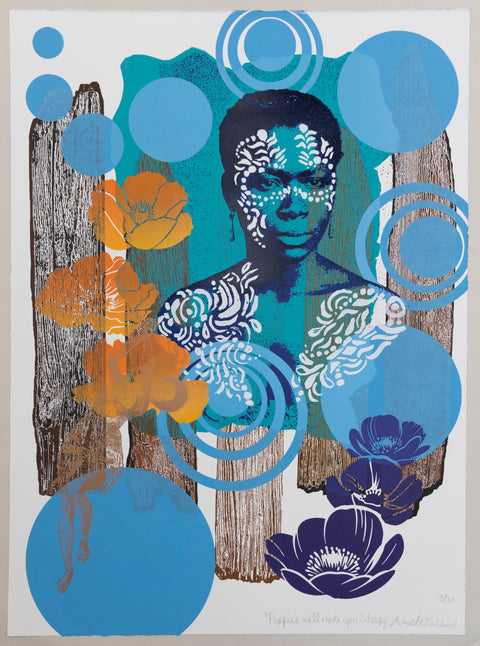
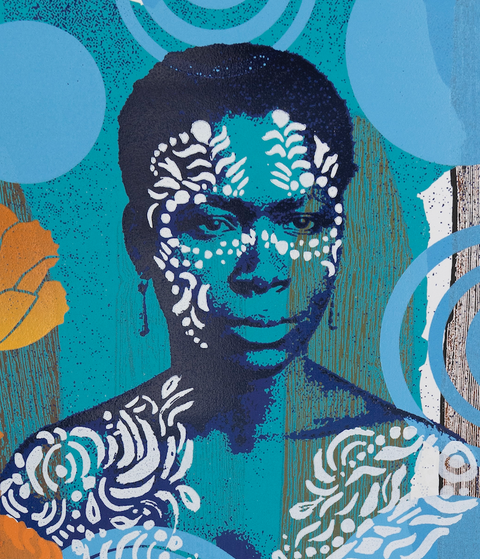
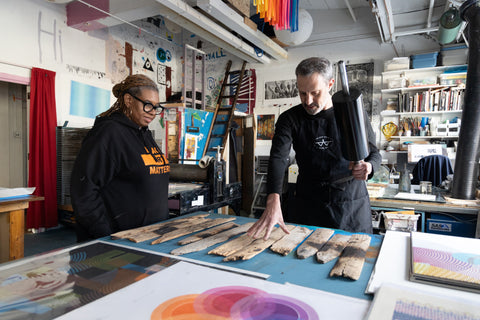
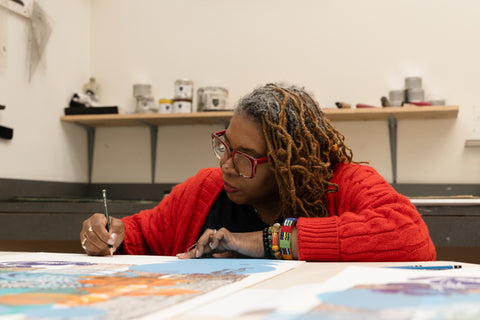
For her PrintLab residency, Ballard collaborated with master printer Alexis Nutini to develop a print that expresses the deliberate tension between beauty and violence that runs throughout her practice, what she calls the “bitter and sweet.” This work began in the archival holdings of the Library of Congress, HBCUs, and the Tulane Amistad Research Center, seeking out centuries old images of historically labelled non-famous, non-enslaved Black subjects. The print’s central image is a black-and-white carte de visite by the German-Brazilian photographer Alberto Henschel around 1869 while in Pernambuco, Brazil. Often intimate portraits, carte de visites were a popular type of photograph during the nineteenth century comprised of small photographs mounted on cardstock and exchanged among friends and family.
Prominent photographer, Alberto Henschel, established studios in several Brazilian cities during the mid-nineteenth century, known for his portraits of both elite citizens and enslaved people. The image depicts a Black woman, likely enslaved, wearing European-style clothing and earrings, highlighting the complex social dynamics of fashion and status in 19th-century Brazil. Little is known of her fate beyond her believed transportation from Brazil to Louisiana in the American South where many of her cards were traded. The image was captured during a period when slavery was still legal in Brazil, which was not abolished until 1888.
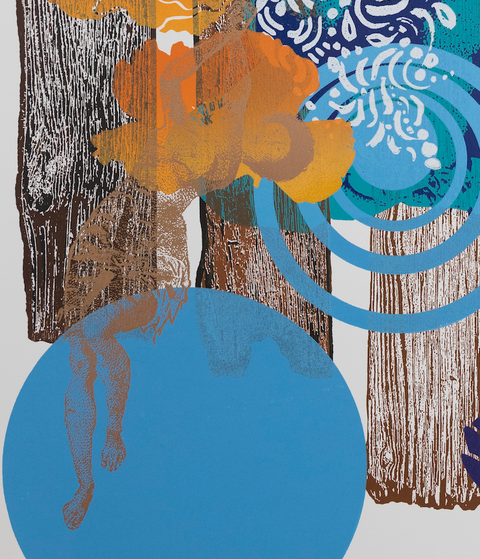
The second image is of an engraving titled Flagellation of a Female Samboe Slave, produced by the artist William Blake. It was created for the 1796 book Narrative, of a Five Years’ Expedition, against the revolted Negroes of Surinam by John Gabriel Stedman. The scene depicts a woman of African and European descent, known as a “Sambo” at the time, tied to a tree and subjected to violence. The image became a significant piece of visual propaganda for the British abolitionist movement and is currently held in multiple British Museums. These are rare images of enslaved people depicted in explicit terms regarding abuse. This was uncommon for travel narratives. Ballard intentionally subverts these archival findings in her work by transforming this violent image into something that reads innocently, almost like a stamp utilizing haint blue. This color is traditionally used in Louisiana, where her father’s family is from, to paint porch doorways and ward
off evil spirits. This pigment is a common motif throughout Ballard’s work acting as a subtle yet protective gesture for the figures she consoles in her compositions. These signals diverge in the gallery as an ancestral call home. Ballard also utilizes poppies to invoke her mother, who loved flowers and passed away in 2019. Since then, floral motifs have become Ballard’s way of keeping her mother present in the work.