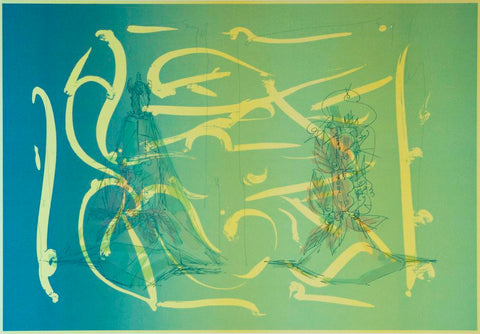
From the Artist
One of the things I remember most is people asking me "Why are you making abstraction? It’s not African American art."And I would always say, "Well … you tell me what it should look like. Jazz is the most abstract of all music. Music is totally abstract. How can you not say there’s a tradition of abstraction?" I would talk about quilts, point out that the geometry of quilts is certainly coming out of abstraction. There is this rich tradition; all you have to do is see it and to use it.
—Excerpted from https://www.michaelrosenfeldart.com/artists/william-t-williams-b1942, accessed 7-14-2021
As an artist, Williams believed that abstraction offered him much greater creative and expressive freedom than figural representation, but he was also wary of painting that was merely about painting. Instead, he searched for a way to make abstraction represent his personal and cultural history. Williams turned to jazz as a stylistic influence that imported associations with a specifically African American contribution to art. He also employed the diamond shape as a visual motif that functioned “as a stabilizing force, a form that interacts compositionally with what’s around it."
—Excerpted from https://africanah.org/in-collection-william-t-williams/, accessed 7-14-2021
The work of William T. Williams is centered around cultural history and personal memories of a childhood spent in urban environments like New York City, where he lived for a while,as well as the southern landscapes of rural North Carolina, where he was born. William’s work is influenced by jazz, and often refers to his own works as “themes" and “variations,” terms typically used in jazz compositions. Bold colors and compositions that mix natural curves with lines are central to Williams mark-making.
—From Brandywine Workshop and Archives records