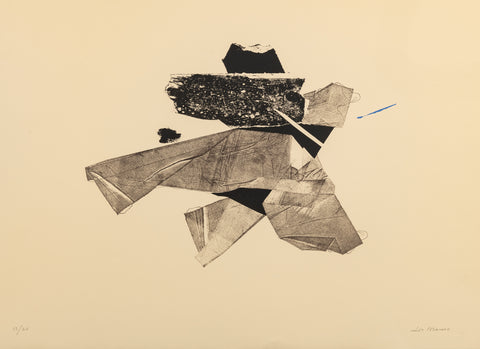
Leo Manso
A Moon
Relief Cut
20 x 28 inches
Edition of 20
Published by Brandywine Workshop and Archives, Philadelphia.
As a young man, Leo Manso was influenced by the art of the 1930s and 1940s in the U.S. but felt that the prevalent Social Realist approach was excessively dogmatic. He was drawn to color as a primary form of expression, and studied Persian miniatures, Siennese masterpieces, Paul Klee, Henri Matisse, Pierre Bonnard, and the folk arts of various nations in order to acquire the knowledge of color and its application. Master-artists from China's Sung Dynasty (960–1179 CE), he realized early on, were a link between East and West, since they had attained the same ambient space, light, and mood as J.M.W. Turner and Claude Monet. Manso was looking for a form of transcendence that he might approach via contemplative involvement.
Because of his fascination with light and mood, Manso insisted on referring to his early work as "Abstract Impressionism." Manso's first paintings were intimate and autobiographical, based on his reactions to nature. He had a lot in common with plein air("open air," referring to painting outdoors) artists and Impressionists in this regard, but unlike them, he didn't try to depict the visible. He expressed his feelings by painting what nature had aroused in him. His main focus was resonances, echoes, and recollections triggered by direct contact with nature.
—Adapted fromhttps://www.juliehellergallery.com/peter-manso, accessed 8-25-2021