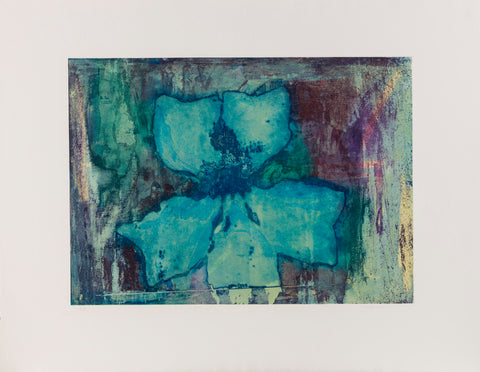
Hee Sook Kim
Being
Intagio
29 x 38 inches
Edition: AP
Published by Brandywine Workshop and Archives, Philadelphia.
From the Artist
For me, it seems that childhood memories always remain in my heart like a strong magic spell.When I came to America to study art, experiencing new cultures, foreign languages, people, and environments challenged me to find my real self, who I was and am. Confusion, struggle, anxiety, anger, pain and agony, and identity have become infused into my work and have evolved to different stages. While I still lived in Manhattan, 9/11 came and left unforgettable scars in my life. One of my friends died. My family and I were locked in for a week. It took sixmonths to clean the air of death out of our neighborhood. Experiencing it all changed me and my work. I started to ponder life and death, self identity and the meaning of being American, and, strangely, a healing. A memory of my childhood came up: my grandmother's garden and affections, theirmagical power over a little girl, the hope of healing.
I create to share experiences I've had in America filtered by the culture I grew up in. When people ask me what artists influenced my work the most and I mention old Korean paintings, it puzzles and confuses those with only knowledge of Western art and its artists. I know it especially challenges those who feel superior to Asian culture.
I use Sumi ink, water based colors, calligraphic brush strokes, strange marks, and texts in foreign languages. As a result, they see waxy surfaces and numerous mysterious layers. A work that doesn't belong to any categories of art makes them wonder:Is it a painting or a print? Where is the root coming from? There is no connection to Western art tradition that they can easily refer to. The strange foreign object has something they never knew before. Something that they cannot clearly describe or explain makes them uncomfortable, yet curious.
Korean culture is especially foreign to some people. They barely remember the Korean War and the involvement of American troops. A female artist from that country who has lived here for about 18 years, who might have become an American by now, is still an alien in this country. Her language is still not perfect. She now has her own culture mixed between two, American and Korean. She doesn't belong anywhere, yet physically does in America.
America is a country of immigrants and has been, with the exception of its native populations, from its political beginnings. Although there shouldn't be any superior cultures or ethnicities, we have had a long history of controversial conflicts. We still do. We are too busy to understand others or too proud to acknowledge other cultures and differences. We think our culture is the greatest one. What is our culture then? It is the culture we've formed and transformed out of many others. I want to evoke this idea through my work. I want viewers to be both challenged and acknowledged by my work.
I deal with spirituality, a subject that has long been disregarded in the contemporary art scene. A desire of healing is another important subject for me. In Asian philosophy, Chi is an important part of human life. The energy we can't see is the vital role of our body and comes from nature itself. Recognizing its power in modern sciences is a valuable change in our culture.My work holds the power of spirituality. I want people to experience it, or at least to be aware of it.
The totality of the above is the work I make. As a result, it is a unique being, possibly a foreign and uncomfortable one, yet a peaceful one you can even meditate on. I want to challenge viewers to recognize them all in their own way and hopefully for them to create their own.
—Excerpted and adapted fromhttps://www.heesookkim.com/artist-statement, accessed 8-21-2021