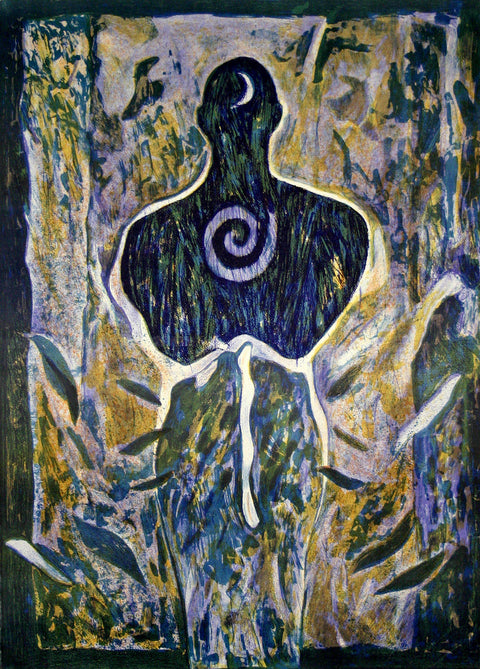
A spiritual connection to nature is evident in the work of Dominican artist Julio Valdez-Gonzalez. The artist relocated to the United States permanently in 1993 when he received a fellowship to work at the Robert Blackburn Printmaking Workshop in New York City. During this time, he adopted the silhouette as a way to reflect on his shifting identity as a recent transplant. A residency invitation to the Brandywine Workshop and Archives, Philadelphia, resulted in Building Myself, a painterly offset lithograph where his body emerges out of plant-like and water forms. The human form consists of a series of vertical blue and green strokes with a Taíno petroglyph at the center and a crescent moon that marks the subject's head. The artist outlined the silhouette in a bright white suggesting the figure emerges from a reflective surface, which contains not only water but also tropical leaves that frame the body.From the Artist
BuildingMyself is an image from a recent series of works [begun in 1995] where I explored the rich cultural heritage of Latin America and the Caribbean. In this particular image, I use more universal symbols, like the spiral and the moon, blended with the iconography and marks that appear in my earlier works.
Building Myselfis also a firm step forward the emphasis on the human figure, in this case, my own silhouette. The image of Santeria (saints) that are an integral part of the faith of my people in the Dominican Republic. These images have been an influence for me recently, and Building Myselfsomehow is influenced by it.
—From Brandywine Workshop and Archives records
The act of surrendering to nature or seeing oneself as inseparable from the Antillean terrain recalls Suzanne Césaire's notion of the "plant-man" when she wrote: "Like the plant, he abandons himself to the rhythm of universal life. He makes no effort to dominate nature...I'm not saying that he makes the plants grow; I'm saying that he grows, that he lives like a plant.” The rootedness in the terrain of the Caribbean islands and waters that Césaire advocated was meant to empower Afro-diasporic subjects to counter the disenfranchised positions brought on by slavery and colonialism, and restore a balance to the tropics through stewardship, reclamation, and opposition to extractive economies.
—Excerpted from Tatiana Reinoza, PhD, from All My Ancestors: The Spiritual in Afro-Latinx Art (2022) exhibition catalog