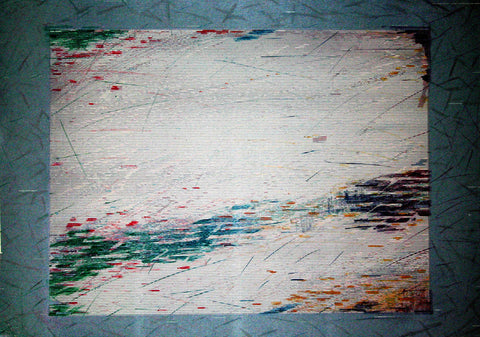
Nori Sato is best known for her personal, lyrical video pieces and her series of large color lithographic prints derived from the subtle lines and dots on untuned television screens. She has been interested in the electronic space between images and the edges and margins of transmission that resolve themselves into meaning as they move toward the center of our vision. In keeping with this preoccupation with the evanescent margins of experience, for example, her contribution to In Public was Transience of Memory, a sculpture that dealt with her memories of coming to the United States from Japan in 1954. The images were a ship, a bird's wing, a set of luggage and a large eye, and the Seattle skyline in the early 1950s. Viewers could superimpose these images on the present bay and city because of their location and the transparency of the steel mesh on which they were printed. The screens were mounted on the safety fence of Pier 50, very near the spot where Sato first stepped into America. The art represented her memory of that now distant experience.From the Artist
This particular print is part of a series of artworks I was making in video and in print on the idea of horizons. You can see in the center of the print that it looks like a TV screen that is made up of horizontal lineswhich also looks like an abstracted landscape. Outside of the screen and floating around are random "signals" that you don't really see when you watch television. The reason it's called Ibis is that I was lucky to be connected with some computer graphic people in the early 80s who had an imaging computer that they called “Ibis,” which is also a name for a bird. These folksallowed several artists toplay around with their system and create images. Now in those days this was a $50,000 + computer, a super high end complicated computer they allowed us to use, and we thought the 16 colors (plus black!) we could use was amazing. Hard to imagine now with so much capability just on our phones. It also had a printer attached that printed our images onto a special coated paper. Though only 16 colors and low resolution, the results were beautiful and exciting. This print is inspired by that early computer and video work with horizons.
—Adapted from interviews conducted by Drexel University students, supervised by Jen Katz-Buonincontro, PhD, 2021–2022
I have been involved with high technology since 1972 when I began working with video. I was trained in printmaking, which, in itsday was a type of high technology. Though I have begun concentrating these days in public and sculptural works, the print work continues to connect to my high technology interest with more traditional ideas.
Technology is a part of myaesthetics. As a part of my conceptual base and I use its concepts with many different media—in video, traditional print media, computer prints, photography, sculpture and wall works, and in public art works. I have been interested in concepts of how humans and human bodies have a direct relationship with some of the precepts of high technology,how machines are designed and often based on human processes or at least seem to be based in human and natural phenomena. In addition, we are in the transition zone, almost making our way through the transition from the Industrial Age to the Information Age, from analog systems to digital systems, from the real world to the simulated or virtual world. What this means for our lives is incredible and it is important and how we think of ourselves and our experiences as human beings.In the print work, I am also investigating ideas and transition, movement from one state to another, connections between technology, man, and nature. I explore edges between the states and the edges of more formal aesthetic issues. I would like people who view my work to become more aware and perceptive and to pay more attention to the complexities of the world around them.
—From Brandywine Workshop and Archives records
—From Brandywine Workshop and Archives records, Seattle Art Museum's exhibition In Public: 1991(1992)