From the Artist
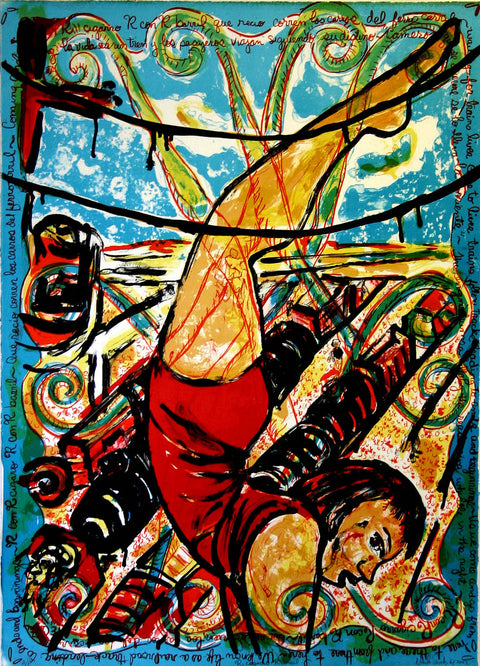
RCigarro, RBarrilis a collaborative piece combining my Train Yardseries with [the wordsof] Texas Chicana poet Norma E. Cantú.
While my work is focusing on the train yard across from my parents' house, Norma is basing her experience from memories of her grandfather who worked for Southern Pacific in the same San Antonio train yard.
We both agree on its urban beauty andhistorical meritfor the Mexican migration and experience. Not only dothe Mexicans work in the train yards but theyalso livein the cargo cars.
Independent Mexican and Latin Texan-Mexican circuses traveled by way of the train yards. These circuses were called "Carpas" and traveled and lived through the train yards. Theiracts varied from circus acts to social/political vaudeville acts.
This print incorporates the historyand poetry of the Texastrain yards. Norma's poem reads as a spiral around the image:R Cigarro R Barril
Que recio corren los carros del ferro carril
Waiting forthe train, lives come to lives
Train follow tracks leading to ends and beginnings
As we come and go from here to there and from there and here
We know life as a railroad track leading to ends and beginnings
R con cigarro R con barril
Que recio corren los carros del ferro barril
Coming and going
La vida es un tren y los pasajeros viajan siguiendo su destino
Camarón que se duerme se lo lleva la corriente
The engine hums a lullaby, the reassuring whistle in the night
R con cigarroR con barril
Que recio corren los carros, los carros del ferro carril
— Norma E. Cantú (2002)—From Brandywine Workshop and Archives records
My work has been an ongoing narrative of past experiences, memories, and modern day concerns. I combine art and philanthropy, creating art whose sole purpose is to be used for the greater good. I started out creating Cascarones due to my longing for family; it turned into a sharing the folkloric art of Cascarones to assist others. The aspect of text on traditional retablos allowed me to venture to connectwith contemporary Latina writers in the Americas. The collaboration with Norma E. Cantu titled “Transcendental Train Yards” offered entry to another realm, creating parallel example of the sensibility of the visual narrative and the literary narrative in a serigraph suite of prints. Outside of working on the Mexican experience with the train yards I also have another project on recording myfamily history.
The catalyst of all my work is the desire to bookmark events and people that may not otherwise be noticed. For that reason, I continue this direction as I focus on a secondary project that I feel has not reached its full potential.
—From Brandywine Workshop and Archives records
As a child I believed that art held a daily purpose for everyone. It not only helped my grandmother worship and communicate to God and her many saints but also uplifted all of us with spiritual images and taught morals based on the narratives of the images. Art that is purposely meant to bless others is what I want to share....
My work has always been connected to creating images that could be purposeful. I have been interested in art that uplifted people by noting them and their lives through a Mexican retablo format, documenting people and actions that would otherwise go unnoticed.
—From Brandywine Workshop and Archives records